

Swing Trading
One Model, Every Timeframe

One Model, Every Timeframe
Setup Dynamics for Swing Trading. Same model, higher timeframe.

This is the fourth article in Barky’s Final Guide series.
Price Action is Fractal
The relationship between timeframes never changes — only the clock does. For day trading, the 2 minute executes inside the 5 minute, using the hourly timeframe for context. Swing trading uses the exact same inter-timeframe dynamics. The 4 hour timeframe executes inside daily context, and the hourly can be used to fine tune risk.
This makes the hourly the most interesting timeframe, because it is where intraday trading meets swing trading. Ultimately, what matters most for swings is the ability to execute fast, so that multiple assets can be traded simultaneously. Therefore, this instruction will only focus on setup dynamic, without a deeper focus on complex setup stacking.
You remember this chart from the Entry Model instruction.

The annotations on that model card state the obvious:
If this is an M5 chart, zoom in to M2
If this is an H1 chart, zoom in to M5 (can use M2 for tighter risk)
If this is daily chart, zoom in to H4 (can use H1 for tighter risk)
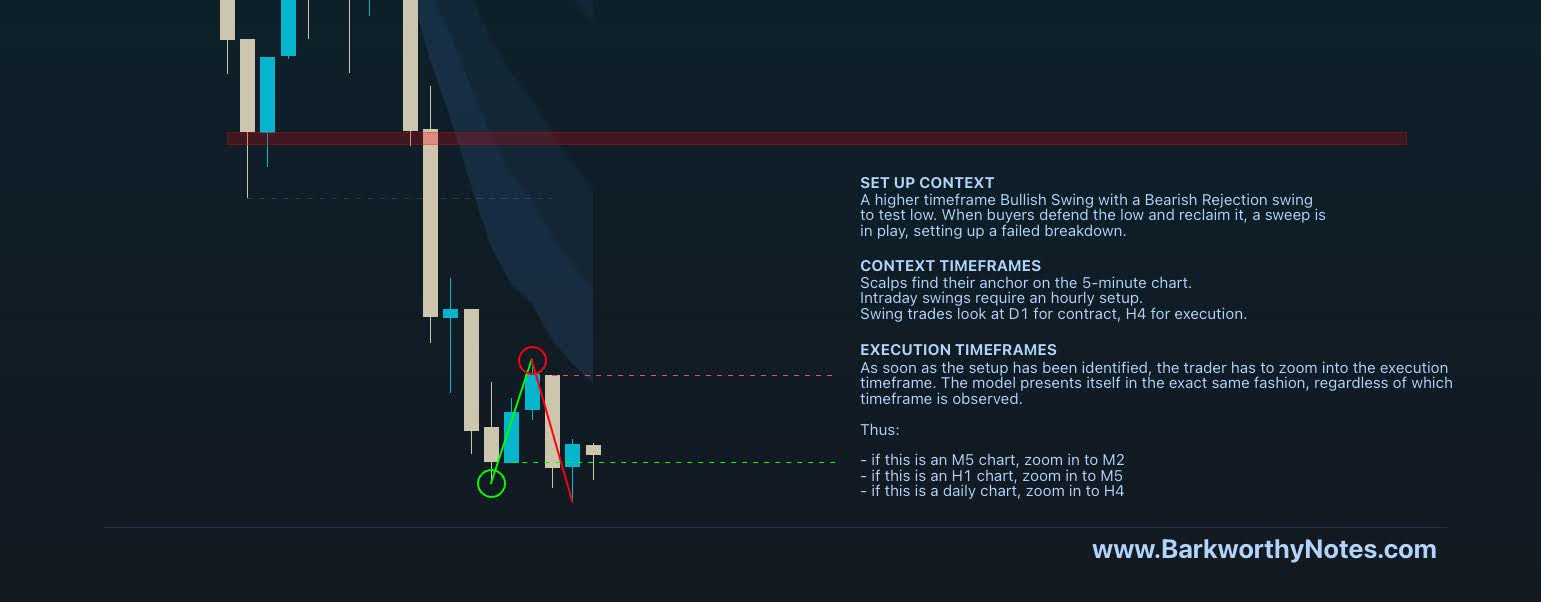
Pick your pair: one timeframe sets the context, and the one below gives the entry.
Context First: Create a Trade Plan
We learned how to read trend structure and create a trade plan in the second article in this series:

The context timeframe shows you the trend and the key levels. The job is to create a trade plan — and wait.